Find the right contracts, get tender alerts instantly, and submit your bids — all in one place. Access now

Case Study

MELM CARE SOLUTIONS North Northamptonshire Council and Northamptonshire ICB — Supported Accommodation for Individuals with Mental Health Needs
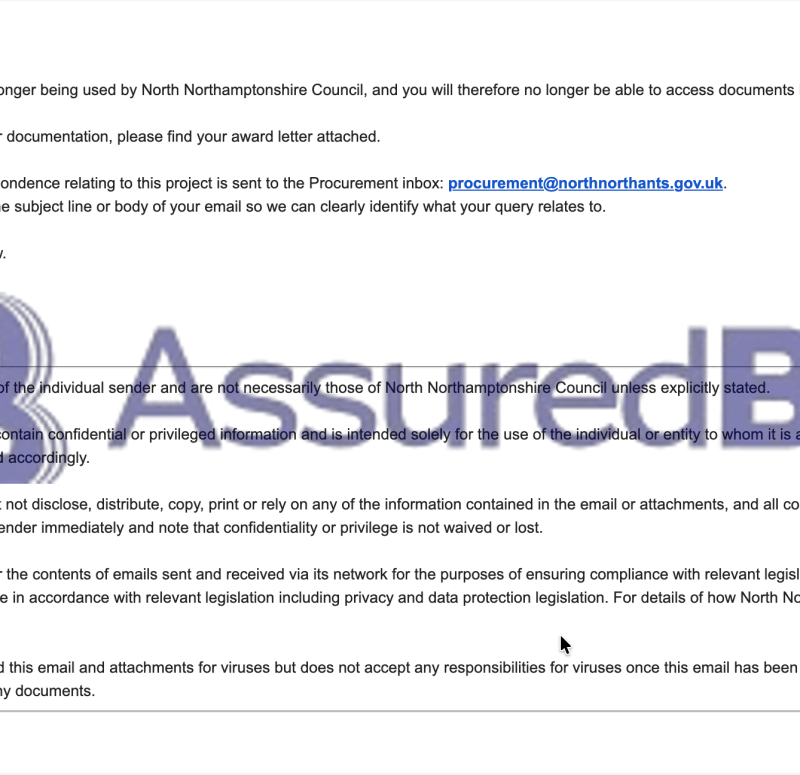
Screenshot 2026-04-16 at 1.59.38 PM

Tender Overview

North Northamptonshire Council ran this procurement jointly with Northamptonshire Integrated Care Board, which made it an uncommon commissioning arrangement from the outset. Most supported living tenders sit with either a local authority or an NHS body. This one sat with both. The framework covered care and support in supported accommodation for adults with mental health needs, structured across two service levels: a Standard Recovery Pathway under Lot 1a and an Enhanced Recovery Pathway under Lot 1b.

The Standard pathway serves individuals whose mental health needs are broadly stable and who are at a stage in their recovery where structured community-based support can help them build skills and move towards greater independence. The Enhanced pathway covers a different set of circumstances entirely. It is designed for individuals with significantly higher levels of complexity, whose presentations are less predictable, whose risk profiles require more intensive management, and where the consequences of a poorly calibrated response are serious. Placement breakdown, hospital admission, and harm are all realistic outcomes when Enhanced pathway support is not delivered well.

MELM Care Solutions provides care and support to adults with mental health needs in supported accommodation. They tendered for both lots and appointed AssuredBID to produce the technical submission. If you run a service in this area and want to understand what a strong bid looks like from the start, our supported living and mental health bid writing service covers the full range of procurement types in this space. On 31 March 2026, North Northamptonshire Council confirmed MELM Care Solutions had been accepted onto the framework on both lots.

The Brief

Client

MELM Care Solutions

Commissioners

North Northamptonshire Council in partnership with Northamptonshire ICB

Contract Reference

NNC00000696

Lot 1a

Supported Accommodation — Recovery Pathway Standard

Lot 1b

Supported Accommodation — Recovery Pathway Enhanced

Lot 1a Score

100%

Lot 1b Score

80%

Award Date

31 March 2026

Result

Accepted on the Framework — Both Lots

Key Challenges

Challenge

Detail

The Provider Selection Regime was unfamiliar territory

The PSR is still relatively new, and many care providers have not yet had to navigate it. This AQP followed the competitive process route under the PSR, which comes with specific rules around how applications are assessed, how decisions are communicated, and how the standstill period works before a contract can be issued. Getting this right was not just about the written responses — it was about understanding the process well enough to move through it cleanly and without errors that could delay or derail the award.

NHS commissioners expect a different level of evidence

The language and evidence standards that NHS commissioners look for are not the same as those used in local authority tenders or private care arrangements. Vow Care had solid care delivery experience, but translating that into responses written for an NHS procurement audience — using the right terminology, referencing the right frameworks, and presenting evidence in the way that NHS evaluators expect — required a different approach to how their work was described and documented.

Every document had to be right first time

The CarePulse eProcurement platform used for this AQP required supporting documents to be uploaded correctly and completely alongside the written responses. Insurance certificates, CQC registration, safeguarding policies, financial information — all of it had to be current, correctly named, and submitted without gaps. A missing or outdated document would have been grounds for rejection, regardless of how well the written responses were drafted.


Challenges Faced

Supported accommodation for adults with mental health needs is one of the harder service areas to write a compelling tender for. The questions commissioners ask in this space go well beyond staffing structures and policy documents. They want to understand how a provider actually responds when someone’s mental state deteriorates in the middle of the night. They want to know what happens during a crisis, how placement stability is maintained when a person is at their most chaotic, and how a service keeps someone safe without defaulting to restriction or escalating unnecessarily to hospital. These are operational questions and they require operational answers.

The marking framework for this tender reflected that expectation. Each lot carried three scored questions and the methodology reserved its highest marks for responses that exceeded the stated requirements, not just met them. A technically correct answer that covered every bullet point without demonstrating genuine depth of thinking would land in the mid-range. Getting to the top of the mark scheme required responses built around real practice, supported by actual evidence and measurable results. Providers preparing for a similar procurement can get a clearer picture of what that process involves on our health and social care bid writing page.

The joint commissioning arrangement between the council and the ICB added a particular dimension to this challenge. NHS and local authority commissioners view supported accommodation through related but distinct frameworks. NHS bodies tend to prioritise clinical risk management, therapeutic approaches, and transitions from inpatient settings into the community. Local authority commissioners focus more on social outcomes, independence building, and community participation. A submission written through only one of those lenses would have read unevenly to a joint evaluation panel applying both.

Lot 1b presented its own distinct test. The Enhanced pathway is not a more intensive version of the Standard service. It requires a fundamentally different capability set, including trauma-informed practice embedded at staff level, co-produced safety and crisis planning for individuals with high unpredictability, and a graduated response model that can de-escalate situations before they reach a point of no return. Demonstrating credibility at this level of complexity requires more than referencing the right frameworks. It requires showing how those frameworks translate into specific, real-world actions taken by a real team.

What We Did

Before a single response was drafted, AssuredBID spent time working directly with MELM Care Solutions to understand how they operate in practice. The focus was on what actually happens within their service, not what their policies describe. How do they structure their teams around individuals with fluctuating needs? What does their approach to early risk identification look like in day-to-day practice? How have they maintained placements in situations where other providers might have asked for a move-on? What outcomes can they evidence and with what data behind them?

That groundwork shaped everything that followed. The evaluation panel for a tender of this nature is made up of people who commission and oversee supported accommodation services. They are experienced readers who can distinguish between a response that describes genuine operational practice and one that assembles the right terminology without anything concrete underneath it.

The three Lot 1a questions covered workforce and resources, contract management and self-monitoring, and identification and management of changes in mental state. For the workforce question, we set out MELM’s team structure, the competencies held within it, how out-of-hours situations and emergencies are managed, how succession planning works, and how placement breakdown risk is actively reduced. We included specific examples of individuals MELM had supported through difficult periods, with measurable outcome data attached. The evaluators described the response as comprehensive and well-evidenced, noting that outcomes were supported by measurable data and specific real-case examples and that it clearly demonstrated existing capacity and experience.

For the contract management question, we built the response around how MELM tracks and responds to service performance in practice, covering feedback mechanisms, reporting structures, quality inspection management, and the remedies available when standards are not met. We also addressed how agency and bank staff are managed within the quality framework. The evaluators rated this response as exemplary and innovative, noting it set a benchmark for best practice and reflected both strong operational capability and a clear commitment to measurable outcomes.

For the mental state deterioration question, we structured the response around MELM’s approach to early identification through relationship-based monitoring, their use of validated clinical assessment tools, systematic documentation practices, and their crisis and safety planning model. The co-produced nature of their safety plans, the graduated response protocols, and the way therapeutic engagement and medication management are embedded throughout the response all featured. The evaluators highlighted the strength of the early identification approach and the robustness of the crisis model, recognising the person-centred and rights-based framing running through the whole answer.

For Lot 1b, the single question asked about placement resilience and trauma-informed crisis support for individuals at the Enhanced level. We wrote a response that drew on MELM’s experience of supporting people with high-complexity presentations, described the trauma-informed models underpinning their approach, and addressed how the organisation structures itself to provide staff with the support and supervision needed to work effectively with this cohort. The response scored 4 out of 5. The evaluators confirmed it addressed all required criteria and recognised MELM’s understanding of the intensity and complexity involved in Enhanced pathway delivery. Their feedback noted that the response could have gone further in setting out specific crisis support models step by step beyond the principles referenced. Providers who want to understand how evaluator feedback like this is used to sharpen future submissions can read more on our tender debrief and improvement page.

The Outcome

North Northamptonshire Council notified MELM Care Solutions of the award decision on 31 March 2026. Both lots were successful. The standstill period was set to conclude on 13 April 2026, after which the contract would be formally issued.

Lot

Service

Score

Result

Lot 1a

Mental Health Supported Accommodation — Recovery Pathway Standard

100%

Accepted on the Framework

Lot 1b

Mental Health Supported Accommodation — Recovery Pathway Enhanced

80%

Accepted on the Framework

Conclusion

A perfect score on Lot 1a across a three-question technical evaluation for mental health supported accommodation is a genuinely strong result. It means the joint evaluation panel found no gaps, no areas needing clarification, and nothing that fell short of what they were looking for. That kind of outcome is a direct reflection of how well MELM’s operational practice was understood and communicated in the submission.

Lot 1b at 80% confirms MELM’s credibility at the more complex end of this service area. The evaluator feedback is specific and actionable. The step up from 80% to a higher score on the Enhanced pathway is a clearly defined task for the next submission, not an open-ended question.

Framework membership gives MELM Care Solutions a contracted position with a joint council and ICB commissioning partnership covering both service levels within North Northamptonshire’s mental health supported accommodation programme. That dual appointment is a formal recognition of their capability across the full range of this service area and positions them well for call-off opportunities throughout the framework term.

If your organisation supports adults with mental health needs or other complex conditions and you want a submission that reflects your genuine delivery capability accurately and with evidence behind it, visit www.assuredbid.co.uk or browse our tender writing case studies to see the results we have delivered for providers across health and social care.

  • Healthcare Tender
  • Private
  • March 2026

Newsletter Sign Up

Newsletter Sign Up

Call us now to speak to a member of our Bid Team: +44 203883 1022