In January 2026, the World Health Organization removed the United Kingdom from its list of countries with measles elimination status. The decision followed 2,911 laboratory-confirmed measles cases in England in 2024, the highest annual figure since 2012, and a child’s death in Liverpool in 2025. It was the second time in a decade that the UK had lost this status, having regained it in 2017 only to lose it again through a sustained failure to maintain the vaccination coverage that elimination requires.
This is a public health failure with direct consequences for health and social care providers. Understanding why it happened, what it means clinically, and how commissioners are responding is no longer optional for providers who want to bid compliantly and credibly in 2026.
What the MMR Vaccine Does and Why Two Doses Matter
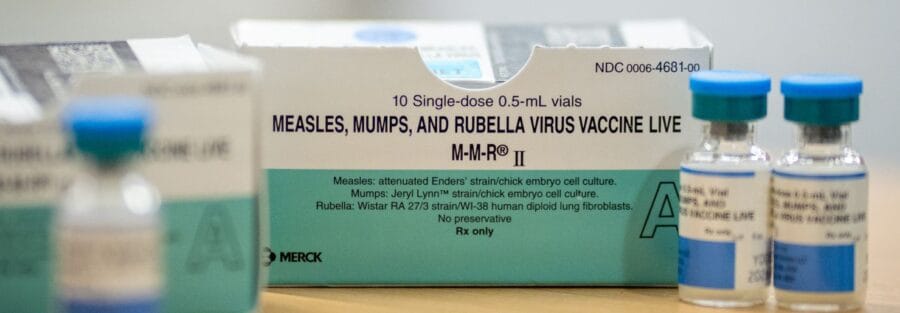
MMR protects against measles, mumps, and rubella. From 1 January 2026, the NHS replaced it with MMRV for children in the routine childhood programme, adding protection against varicella. The MMR vaccine remains available for anyone born on or before 31 December 2019 who missed vaccination. Two doses are required for full protection, and over 99 per cent of those who receive both doses will have lifelong immunity against measles and rubella.
The WHO sets 95 per cent two-dose population coverage as the threshold for measles elimination. England has never met this target nationally. In 2024/25, first-dose coverage by age two was 88.9 per cent. Second-dose coverage by age five was 83.9 per cent. That 11-point gap between where England is and where it needs to be is not a minor statistical shortfall. Measles is one of the most contagious pathogens in existence. One infected person can infect nine out of ten non-immunised close contacts. At current coverage levels, sustained community transmission is mathematically inevitable, and the case data confirms it.
London Is at the Centre of the Crisis
Between 1 January and 9 March 2026, 235 laboratory-confirmed measles cases were reported in England. Sixty-two per cent of them were in London. This follows the pattern of 2024, when a large London outbreak contributed significantly to the national case count. The reasons London consistently records the lowest MMR coverage and the highest case numbers in England are structural, not incidental.
London has high population density, constant population mobility, large communities of recent migrants who may not have been registered with a GP or reached by NHS vaccination outreach, and pockets of deep deprivation where contact with primary care is inconsistent. The legacy of the fraudulent 1998 Lancet paper, which falsely claimed a link between the MMR vaccine and autism, continues to affect uptake in specific communities despite the claim having been thoroughly and repeatedly disproven. These factors combine to create geographic clusters of unvaccinated people in which measles, once introduced, spreads rapidly.
Why This Is a Workforce Issue, Not Just a Public Health Issue
For care providers, the MMR gap is not only a concern about the populations being supported. It is a direct workforce risk. Care staff who are unvaccinated against measles and who work across multiple households, communal residential settings, or shared day services are a transmission vector. A care worker who develops measles during a period of community transmission can unknowingly expose a string of service users before symptoms become apparent, including people who cannot be vaccinated because they are immunocompromised.
This matters most for providers delivering services to people on immunosuppressive medications, people with haematological conditions, organ transplant recipients, and older adults with compromised immune function. These groups rely entirely on herd immunity for protection against measles. When community coverage falls to current levels in London, that protection is materially reduced and the responsibility shifts in part to the providers who employ the staff moving through their lives.
Providers should confirm the MMR vaccination status of all staff, document it formally, establish a clear process for staff with unknown vaccination history, and ensure that any agency or bank workers are subject to the same requirements. These are not aspirational standards. They are becoming scored criteria in tender quality governance sections as commissioners respond to the loss of elimination status.
What Commissioners Now Expect to See in Bids
The UK losing WHO measles elimination status will accelerate scrutiny of vaccination governance across all registered care settings. Providers bidding for domiciliary care contracts, supported living frameworks, nursing care placements, or residential care tenders will increasingly encounter questions about staff vaccination policy, documented compliance rates, and outbreak management protocols for vaccine-preventable diseases. Generic infection control policies that predate the current outbreak will not score well against these questions.
Strong bids will evidence a named clinical lead for infection surveillance, a staff vaccination policy with documented MMR compliance data, a process for onboarding unvaccinated staff, and a clear protocol for managing suspected measles cases that prevents staff from entering multiple care settings while symptomatic.
AssuredBID
Measles elimination status lost, London at the epicentre, and commissioners increasingly embedding vaccination governance into tender quality criteria: the MMR situation is a live bidding issue in 2026, not a future concern. Our bid management services help you build the clinical governance evidence that commissioners are scoring right now.
Book a free consultation at assuredbid.co.uk/book-a-consultation