Find the right contracts, get tender alerts instantly, and submit your bids — all in one place. Access now

Case Study

Barnsley Metropolitan Borough Council — Community and Supported Living Services Light Touch Framework
Screenshot 2026-07-01 at 5.25.59 PM

Tender Overview

Barnsley Metropolitan Borough Council structured its Community and Supported Living Services Light Touch Framework around distinct service groups, each split into three tiers of need. Each service group carries a Tier 1 for standard support, a Tier 2 for complex support, and a Tier 3 for enhanced support involving higher levels of risk and clinical complexity. The council evaluated each tier independently using a detailed case study methodology built around fictional service users, referred to throughout the assessment as P, each with their own history, risks, and support needs.

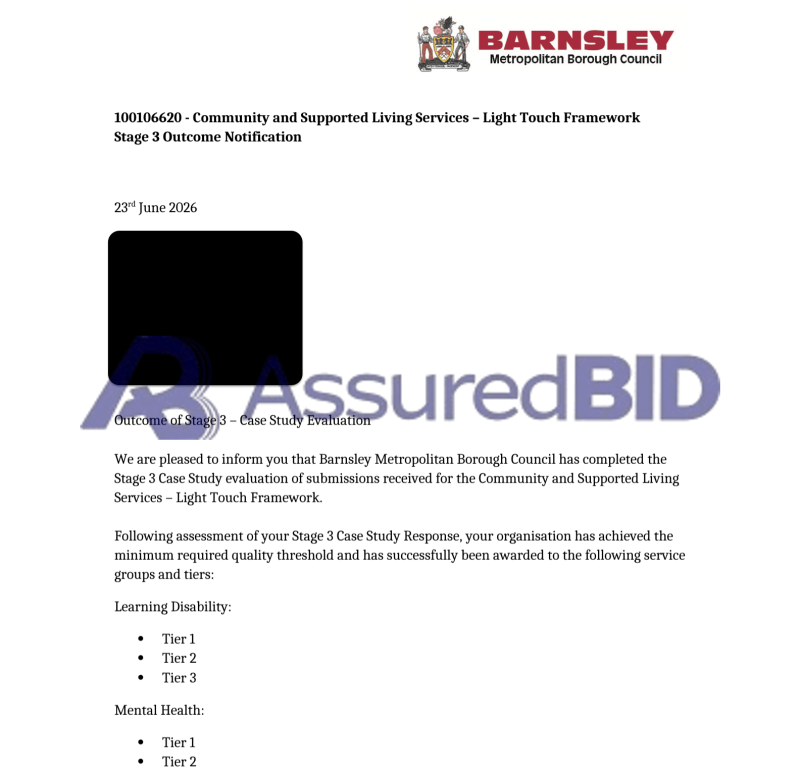
Alicelyn Healthcare Ltd, based in Sheffield, applied across multiple service groups. AssuredBID wrote the Stage 3 Case Study submission. On 23 June 2026, Strategic Procurement Business Partner Jade Popplewell confirmed the result. Alicelyn Healthcare was successfully awarded all three tiers in Learning Disability, Tier 1 and Tier 2 in Mental Health, and all three tiers in Autistic Adults.

The Brief

Client

Alicelyn Healthcare Ltd

Commissioner

Barnsley Metropolitan Borough Council

Framework

Community and Supported Living Services — Light Touch Framework

Reference

100106620

Evaluation Stage

Stage 3 — Case Study Evaluation

Notification Date

23 June 2026

Result

Awarded across Learning Disability, Mental Health, and Autistic Adults

Key Challenges

A case study evaluation of this kind is one of the more demanding formats in adult social care procurement. Rather than asking generic questions about policies and processes, Barnsley gave bidders a fictional individual, P, with a specific and detailed background, and asked how the provider would actually support that person. The scoring rewarded responses that were operationally specific to that exact scenario. Evaluator comments throughout the feedback repeatedly point to the same theme: where a response described what P specifically needed and how the provider would meet it, scores were strong. Where a response described good practice in general terms without tying it back to P’s particular situation, marks were lost.

Eight separate case studies across three service groups and multiple tiers is a substantial body of work, and each one required genuinely distinct expertise rather than a recycled response with different details changed. The Autistic Adults Tier 3 scenario required an understanding of forensic discharge planning and RRN-aligned restrictive practice. The Learning Disability Tier 2 scenario centred on a hospital discharge under the Mental Capacity Act and Mental Health Act. The Mental Health scenarios involved recovery-based intervention, dynamic risk assessment, and tenancy sustainment for individuals with fluctuating presentations. Writing convincingly across that range meant treating each tier as its own specialist brief rather than a variation on a theme. Our case study and scenario-based tender writing approach is built specifically around this kind of evaluation methodology.

Our Approach

For Learning Disability, the Tier 1 response built a comparable case example around Alicelyn Healthcare’s actual experience supporting someone with similar anxiety and withdrawal presentations, and tied the response explicitly to multi-agency coordination and tenancy sustainment. It scored a 4, Good, with evaluators noting the relevant experience evidenced through a comparable case example and the outcome-focused monitoring built into the response. The Tier 2 response, centred on a hospital discharge scenario, set out a clear MDT-led framework aligned to the Mental Capacity Act and Mental Health Act, with readmission prevention built in, and scored a 3, Acceptable. The Tier 3 response addressed MoJ and forensic governance directly, alongside trauma-informed practice and environmental risk management, and also scored a 3, Acceptable.

For Autistic Adults, both Tier 1 and Tier 2 scored a 4, Good, the strongest consistent result across the submission. The Tier 1 response was built around co-production, independence-building, and a structured support model using accessible communication and sensory-aware tools, with evaluators specifically noting the well-structured support model and the integration of family partnership and risk management. The Tier 2 response addressed urgency, PBS and low-arousal approaches, and rota stabilisation, with evaluators highlighting the rapid specialist triage and the robust safeguarding oversight demonstrated. Tier 3 scored a 3, Acceptable, with the response recognising forensic discharge complexity and physical health needs alongside epilepsy and challenging behaviour, supported by RRN-trained staff and continuous behavioural data monitoring.

For Mental Health, both Tier 1 and Tier 2 scored a 3, Acceptable, with evaluators noting strong evidence of safeguarding, recovery-based interventions, and dynamic risk assessment across both responses. The Tier 1 response demonstrated understanding of adult safeguarding processes and Section 42 investigation routes, with clear consideration given to the root causes of deterioration in mental health and a flexible, graded approach to rebuilding community access. The Tier 2 response showed collaborative working with other professionals, family and social network mapping, and early intervention built around a recovery-focused enabling model. Our mental health and complex needs tender writing service informed how each of these responses was structured around real, evidenced practice rather than general statements of approach.

Results

Barnsley Metropolitan Borough Council confirmed the result on 23 June 2026.

Service Group

Tier

Score

Result

Learning Disability

Tier 1 — Standard

4 (Good)

Awarded

Learning Disability

Tier 2 — Complex

3 (Acceptable)

Awarded

Learning Disability

Tier 3 — Enhanced

3 (Acceptable)

Awarded

Autistic Adults

Tier 1 — Standard

4 (Good)

Awarded

Autistic Adults

Tier 2 — Complex

4 (Good)

Awarded

Autistic Adults

Tier 3 — Enhanced

3 (Acceptable)

Awarded

Mental Health

Tier 1 — Standard

3 (Acceptable)

Awarded

Mental Health

Tier 2 — Complex

3 (Acceptable)

Awarded

Before the framework agreement can be issued, Barnsley requires confirmation of specific insurance cover, including Employer’s Liability at a minimum of £10 million, Public Liability at a minimum of £5 million, Professional Indemnity at a minimum of £5 million, and Medical Malpractice or Treatment Liability insurance in line with industry practice. This needs to be submitted before the standstill period concludes, which the council confirmed will run from 23 June to 2 July 2026.

Conclusion

Eight tier awards across three service groups, with full clean sweeps in Learning Disability and Autistic Adults, is a strong result on a framework evaluated through detailed, individual-specific case studies rather than generic policy questions. The Autistic Adults result in particular, scoring Good across both Tier 1 and Tier 2, stands out and reflects real depth in how Alicelyn Healthcare’s support model for autistic adults was articulated and evidenced.

The consistency across Learning Disability is equally notable. Securing all three tiers, spanning standard support through to enhanced forensic and hospital discharge scenarios, demonstrates that Alicelyn Healthcare’s experience translates credibly across the full spectrum of need within that service group. The Mental Health results add a third area of confirmed capability, with both tiers passing on the strength of evidenced safeguarding practice and recovery-focused intervention.

Framework membership across Learning Disability, Mental Health, and Autistic Adults gives Alicelyn Healthcare a substantial, multi-tier commissioning relationship with Barnsley, once the outstanding insurance evidence has been submitted and the standstill period concludes. For a provider building a presence in South Yorkshire’s adult social care commissioning landscape, that is a strong and varied foundation to build from.

If your organisation is preparing for a case study or scenario-based tender evaluation, particularly across learning disability, autism, mental health, or complex needs services, talk to us about how we approach this kind of assessment. You can see more of our work on our case studies page, or get in touch directly through our contact page to talk through your next submission.

  • Healthcare Tender
  • Private
  • June 2026