Navigating the world of tenders can feel complex, especially when the rules themselves have recently changed. Yet understanding the different types of tender, and how the tendering process works, is one of the most valuable things a care provider can do to compete for, and win, public contracts.
A tender is, at heart, a formal offer to supply goods or services under defined terms, usually as part of a competitive process. This guide explains what tenders are, the types you’ll encounter under the current UK rules, the documents involved, and how bids are submitted and evaluated, so you can approach any opportunity with confidence.
- What Is a Tender? Understanding the Basics
- The Rules Have Changed: The Procurement Act 2023
- Types of Tender Explained
- The Tendering Process: Step by Step
- Key Tender Documents and Their Importance
- Tender Submission: Requirements and Best Practice
- Tender Evaluation: How Bids Are Assessed
- Tender Management: Ensuring a Smooth Process
- Common Tender Requirements Across the Sector
- Conclusion: Understanding Tenders Is the First Step to Winning Them
What Is a Tender? Understanding the Basics
A tender is a formal offer to supply goods or services, submitted in response to a buyer’s published requirements. In the public sector, it’s the mechanism through which contracting authorities award contracts fairly, transparently, and in line with the law.
The purpose of tendering is to ensure that public money is spent well and that every capable supplier gets a fair opportunity to compete. When a buyer issues a tender, they set out clear requirements and expectations so that suppliers understand exactly what’s needed and how their bid will be judged.
The key elements of a tender usually include the specification and scope of what’s required, the terms and conditions of the contract, the criteria against which bids will be assessed, and the deadline for submission. Understanding each of these components is the foundation of a structured, competitive bid, a theme we explore in depth in Mastering the Tender Document.
The Rules Have Changed: The Procurement Act 2023
Before looking at the types of tender, it’s essential to understand the framework you’re now bidding into. On 24 February 2025, the Procurement Act 2023 came into force, replacing the previous Public Contracts Regulations 2015 across England, Wales, and Northern Ireland. (Scotland operates its own separate regime.)
The Act deliberately simplified the old, prescriptive list of procurement procedures into a much smaller, more flexible set. So while you may still hear older terms like “restricted”, “negotiated”, or “competitive dialogue”, the public procurement routes available today are fewer and work differently. Bidding on out-of-date assumptions is a genuine risk, so it pays to understand the current picture.
Types of Tender Explained
Under the current regime, most public contracts are awarded through one of a small number of routes. Understanding which one you’re facing shapes how you prepare.
The Open Procedure
The Open Procedure is the most familiar route, and the only one with a fixed, prescribed form in the Act. It’s a single-stage process: the opportunity is advertised, and any interested supplier can submit a full tender, with no separate shortlisting round beforehand.
Everything you need is provided up front, and all suppliers receive the same information. Because there’s no restriction on who can bid, the Open Procedure maximises competition and is well suited to straightforward contracts. For you as a bidder, it means you submit your complete response in one go, so there’s no second chance to strengthen a shortlisting stage; the tender has to be right first time.
The Competitive Flexible Procedure
The Competitive Flexible Procedure is the significant innovation of the Procurement Act. Rather than following a rigid template, it gives contracting authorities the freedom to design their own procurement process, provided it remains fair, transparent, and proportionate.
In practice, this means a buyer can build a bespoke procedure to suit the contract, potentially including a shortlisting stage, multiple rounds, negotiation, dialogue, demonstrations, or proof-of-concept stages. It effectively replaces the old multi-stage procedures (such as restricted, negotiated, and competitive dialogue) with a single, adaptable route.
The practical implication for providers is important: with this procedure, you can’t assume how the process will run. You must read each tender carefully to understand the stages, timings, and criteria the buyer has chosen, and adapt your bidding strategy to them. Where a shortlisting stage exists, getting through it is your first priority; where negotiation or dialogue is involved, your team needs the commercial skills to engage effectively.
Direct Award
In certain defined circumstances, a buyer can award a contract directly, without a competitive process, for example, where only one supplier can realistically provide what’s needed, or in specific situations set out in the Act. This is the exception rather than the rule, and it’s tightly constrained to preserve fairness and value for money.
Frameworks and Dynamic Markets
Two further routes are so important to care providers that they deserve mention here.
A framework is a pre-approved list of suppliers, established through a single competitive process, from which buyers can award contracts (“call-offs”) over the framework’s lifetime. Winning a place doesn’t guarantee work; it makes you eligible to be considered for it.
A dynamic market (which replaces the old Dynamic Purchasing System) is an open list of qualified suppliers that, unlike a framework, you can apply to join at any time. Contracts are then awarded through competitions among the members.
Both are central to how health and social care is commissioned, and choosing which to pursue is a strategic decision in itself. We unpack the trade-offs in Frameworks, Dynamic Markets and Spot Purchase.
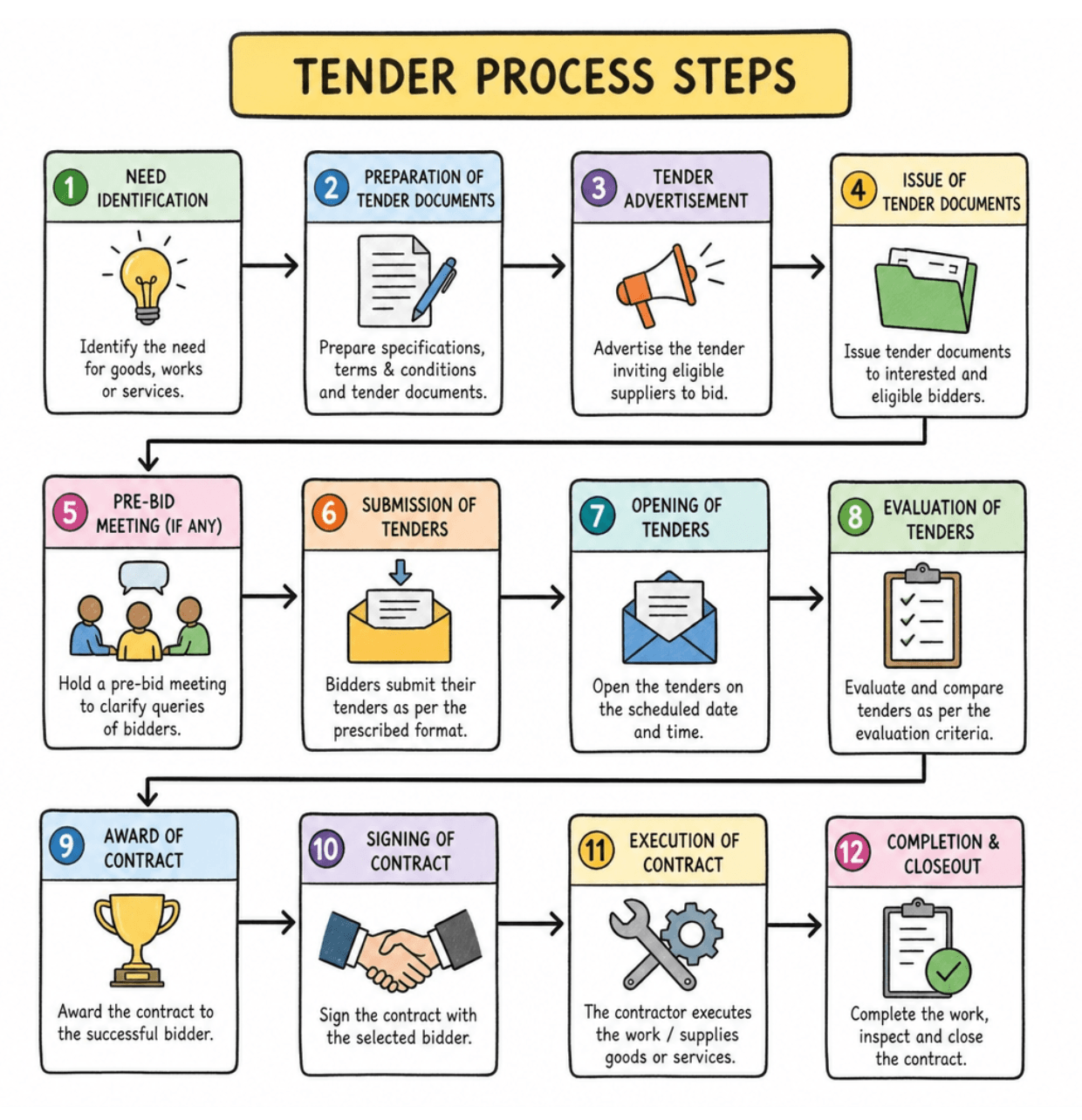
The Tendering Process: Step by Step
Whichever route applies, the underlying process follows a recognisable shape.
- Identifying the need. The buyer establishes what goods or services they require, which begins the procurement cycle.
- Preparing the tender documents. The authority sets out its requirements, specification, terms, and evaluation criteria.
- Advertising the opportunity. Public tenders above the relevant thresholds are published centrally on the Find a Tender service, and often on Contracts Finder, so suppliers can find them.
- Submitting bids. Suppliers prepare and submit their responses through the specified portal, following every instruction precisely.
- Evaluating tenders. Bids are assessed against the published criteria, usually by a panel, and scored.
- Awarding the contract. The authority awards to the supplier offering the best assessment of quality and price, publishes a contract award notice, and observes a standstill period before signing.
Each stage rewards careful planning. The providers who win aren’t necessarily the biggest; they’re the ones who understand the process and prepare methodically for it.
Key Tender Documents and Their Importance
Tender documents are the backbone of any bid. They tell you what the buyer wants, how to respond, and how you’ll be judged, so reading them closely is non-negotiable.
A typical tender pack includes instructions to bidders explaining how to submit; a specification or statement of requirements setting out exactly what’s needed; the terms and conditions that will govern the contract; the evaluation criteria and their weightings; and the pricing forms or schedules you must complete. Together, these guide you in producing a compliant, responsive submission, and misreading any one of them can cost you marks or lead to disqualification.
Clear, well-understood documents make for a smoother process on both sides. For the bidder, they’re the single source of truth for what a winning response looks like.
Tender Submission: Requirements and Best Practice
Submitting a tender is an exercise in precision. A strong response can still be lost through a careless submission, so attention to detail matters enormously.
Start by understanding the specific requirements: the format and structure demanded, the submission deadline, the need to respond fully to every part of the specification, and any mandatory documents or pricing schedules. Failing to meet these can lead straight to disqualification, however good your underlying offer.
A few habits consistently strengthen a submission: respond to every question in the order asked, keep your writing clear and evidence-led, complete every required document, and build in a proper review before you submit to check accuracy and compliance. Above all, submit early, uploading well before the deadline protects you against last-minute portal problems. We cover the common pitfalls, and how to avoid them, in 7 Common Tender Mistakes That Cost Care Providers Contracts.
Tender Evaluation: How Bids Are Assessed
Evaluation is where the contract is decided. Buyers assess bids against predefined criteria, and while price always matters, it’s rarely the only factor. Quality, delivery, experience, social value, and compliance with the specification all typically play a part.
A structured, scored evaluation keeps the process objective and fair. Evaluators usually mark each response against a published scale, then combine quality and price scores according to the stated weightings to identify the best overall value. Understanding this is a genuine advantage: it means writing your bid for the people scoring it, focusing your strongest evidence where the marks actually sit, rather than spreading effort evenly across every question.
Under the Procurement Act, unsuccessful bidders also receive an assessment summary explaining how their tender scored, which makes it easier to learn from a result and improve next time.
Tender Management: Ensuring a Smooth Process
Behind every strong bid is good tender management, the coordination of the whole effort from opportunity to submission. It means clear planning, managing documents and deadlines, keeping contributors aligned, and controlling quality throughout.
For providers juggling several opportunities, technology increasingly makes this manageable. A platform that helps you find relevant tenders, track deadlines, assess your fit, and organise your response turns a chaotic scramble into a structured process. That’s precisely what the BIDsuite platform is built to do, matching you to the right opportunities and helping you judge your chances before you commit.
Common Tender Requirements Across the Sector
While every tender differs, most share a common core of requirements. Buyers typically want evidence of financial standing, so they can be confident you’ll deliver; proof of technical and professional capability, showing you can meet the specification; relevant past experience and references; and compliance with the regulations and standards that apply to your sector.
In health and social care specifically, that regulatory dimension is central, from CQC or Ofsted registration and ratings to safeguarding, insurance, and sector-specific policies. Understanding and evidencing these requirements thoroughly is essential to a competitive submission across every service line, whether you deliver domiciliary care, supported living, or children’s services.
Conclusion: Understanding Tenders Is the First Step to Winning Them
The tendering landscape has changed, but the fundamentals of success haven’t. Understanding what a tender is, which procedure you’re facing, what the documents require, and how bids are evaluated gives you the foundation to compete effectively for the contracts that grow your business.
Under the Procurement Act 2023, the routes are fewer but more flexible, which rewards providers who read each opportunity carefully and prepare with genuine understanding rather than assumption. Get to grips with the type of tender in front of you, align your bid to how it will be assessed, and manage the process well, and you put yourself in the strongest position to win. Our case studies show what that looks like in practice.
Ready to win more of the right contracts? For over five years, AssuredBID has helped care providers across the UK understand the tendering process, prepare stronger bids, and win the work that grows their business. If tenders are taking up too much of your team’s time, or you keep coming second, we can help.
Book a free consultation with our tender experts to talk through your next opportunity, explore our tender writing and bid management services, and follow AssuredBID on social media for practical guidance you can actually use.
You can also explore the BIDsuite platform to find the right tenders, get instant alerts, and check your chances of winning before you commit.